AI voice agent is a MetaAI voice assistant used to augment agentic search queries on the FB app, leveraging the existing capabilities from MetaAI’s native function.
Project
AI Voice Agent
Timeline
H1 '2025
Team
Facebook Design Systems
Context
In early H1 ‘25, the Facebook foundation team partnered with Search to explore and validate MetaAI’s voice agent feature integration within Facebook’s Search funnel.
This was partly to validate and adopt MetaAI’s latest voice assistant feature — which was a safer, generic alternative to the AI-celebrity voice-mode from 2023 — but more importantly to pivot away from legacy MetaAI suggestion pills that was driving feed view regression and app clutter.
This was also about evolving and optimizing agentic-systems on Facebook, where the infrastructure and capabilities were robust, while the delivery mechanism and product integration strategy was still being explored.
The team saw an opening for a partnership with Search team, while leveraging MetaAI’s infrastructure to: 1) Validate MetaAI voice agent feature impact within core search funnels. 2) Demonstrate how product x systems partnerships reduces tech debt, accelerate experimentation and deliver product and ecosystem impact.
Our hypothesis — voice agent and conversational AI is a value multiplier for search funnels as it compressing query time and eliminating friction in user’s query and search pivots, accelerate content discovery and supercharging ranking and recommendation models through hyper personalization.
Strategy
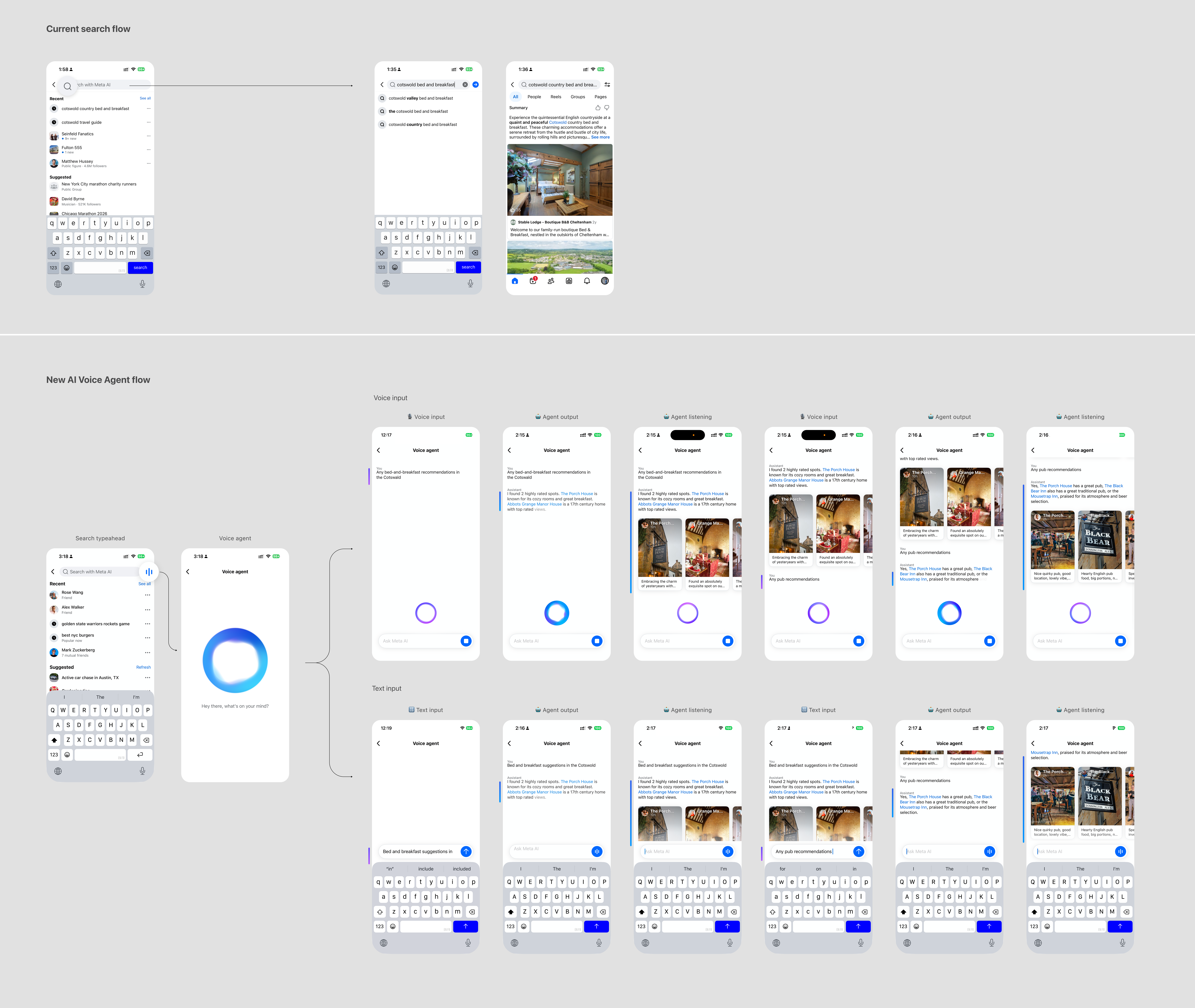
The scope and intent: The search engine today already has MetaAI’s agentic integration embedded (under the centralized architecture), this meant no reconstitution of user behavior is needed. The scope is simply introducing a new interface, modality to supercharge an existing agentic search experience.
Voice shader: We adopted and scaled MetaAI’s voice-shader (source code, pipeline, and API set up), as cross-platform consistency is foundational to maintaining user trust. We then augmented voice states with system color, motion tokens, introduced additional motion and scaling behaviors (refined and standardized using XCode + Cursor), all without deviating away from what MetaAI source code provides.
Modality: Having a TTS fallback, and prioritizing text input capabilities equally is foundational to an accessible MVP. A performant multi-modal experience allows us to balance the speed and low friction of [voice], with the precision and control of [text] (allowing for edits, and error rates that arise from speech recognition)
Optimizing AI summary IA: Moving to a voice agent interface meant rethinking content structure to balance agent conversation with content output. Research has shown that voice agents are optimized for content distillation based on queries that range from specific to undefined. Conversational prompting makes the seeding of content in the form of short form reels, videos more ideal than a conventional content feed. The differentiation in how information is aggregated and presented within the context voice agent is an intentional and important one.
Outcome
The MVP was finalized and tested in H2’25. We saw a boost in session retention, ad impressions and topline metrics, validating voice agent ability to capturing active intent from users, without solely relying on the passive engagement of content feed.
As the team submitted launch approval, Meta AI’s new Muse Spark model upgrade and rebranding efforts were announced, so the team made the strategically sound decision to defer deployment.
AI voice agent is a MetaAI voice assistant used to augment agentic search queries on the FB app, leveraging the existing capabilities from MetaAI’s native function.
Project
AI Voice Agent
Timeline
H1 '2025
Team
Facebook Design Systems
Context
In early H1 ‘25, the Facebook foundation team partnered with Search to explore and validate MetaAI’s voice agent feature integration within Facebook’s Search funnel.
This was partly to validate and adopt MetaAI’s latest voice assistant feature — which was a safer, generic alternative to the AI-celebrity voice-mode from 2023 — but more importantly to pivot away from legacy MetaAI suggestion pills that was driving feed view regression and app clutter.
This was also about evolving and optimizing agentic-systems on Facebook, where the infrastructure and capabilities were robust, while the delivery mechanism and product integration strategy was still being explored.
The team saw an opening for a partnership with Search team, while leveraging MetaAI’s infrastructure to: 1) Validate MetaAI voice agent feature impact within core search funnels. 2) Demonstrate how product x systems partnerships reduces tech debt, accelerate experimentation and deliver product and ecosystem impact.
Our hypothesis — voice agent and conversational AI is a value multiplier for search funnels as it compressing query time and eliminating friction in user’s query and search pivots, accelerate content discovery and supercharging ranking and recommendation models through hyper personalization.
Strategy
The scope and intent: The search engine today already has MetaAI’s agentic integration embedded (under the centralized architecture), this meant no reconstitution of user behavior is needed. The scope is simply introducing a new interface, modality to supercharge an existing agentic search experience.
Voice shader: We adopted and scaled MetaAI’s voice-shader (source code, pipeline, and API set up), as cross-platform consistency is foundational to maintaining user trust. We then augmented voice states with system color, motion tokens, introduced additional motion and scaling behaviors (refined and standardized using XCode + Cursor), all without deviating away from what MetaAI source code provides.
Modality: Having a TTS fallback, and prioritizing text input capabilities equally is foundational to an accessible MVP. A performant multi-modal experience allows us to balance the speed and low friction of [voice], with the precision and control of [text] (allowing for edits, and error rates that arise from speech recognition)
Optimizing AI summary IA: Moving to a voice agent interface meant rethinking content structure to balance agent conversation with content output. Research has shown that voice agents are optimized for content distillation based on queries that range from specific to undefined. Conversational prompting makes the seeding of content in the form of short form reels, videos more ideal than a conventional content feed. The differentiation in how information is aggregated and presented within the context voice agent is an intentional and important one.
Outcome
The MVP was finalized and tested in H2’25. We saw a boost in session retention, ad impressions and topline metrics, validating voice agent ability to capturing active intent from users, without solely relying on the passive engagement of content feed.
As the team submitted launch approval, Meta AI’s new Muse Spark model upgrade and rebranding efforts were announced, so the team made the strategically sound decision to defer deployment.