Walmart Store Map
Context
Store Map helps Walmart customers cut the time it takes to locate a department, aisle, or product—surfacing that information upfront and directing shoppers to the exact spot in a fraction of the time.
For the business, it also drives awareness of points of interest and digital services like Auto Care, Vision Center, and Pharmacy. When the feature first launched in 2018, it was hosted on the web, which made a bottom-sheet map interaction hard to enforce. The resulting lack of navigational flexibility measurably impacted the bottom line, prompting the business to migrate the map in-app—opening up new possibilities to elevate the experience. As Store Map Lead, I owned that redesign.
Problem
The mandate was to improve in-store navigation and way-finding by eliminating the confusion—in messaging and visual affordances—that added friction to what should have been a seamless experience.
The core breakdown: customers couldn't reliably connect what they were looking for with where it was. Search results, item browsing, and map way-finding lived as disconnected layers, leaving shoppers to bridge the gap themselves—often hitting dead ends or misreading the map entirely.
Opportunity
Migrating the map in-app unlocked the chance to rebuild Store Map as a single, flexible unit—one where browsing item results and locating them on the map became one continuous motion rather than a series of disjointed screens.
The bet: by unifying these layers and giving customers navigational flexibility to pivot at any point, we could eliminate the dead-end experiences and multi-pin confusion undermining both the customer journey and the feature's business value.
Research
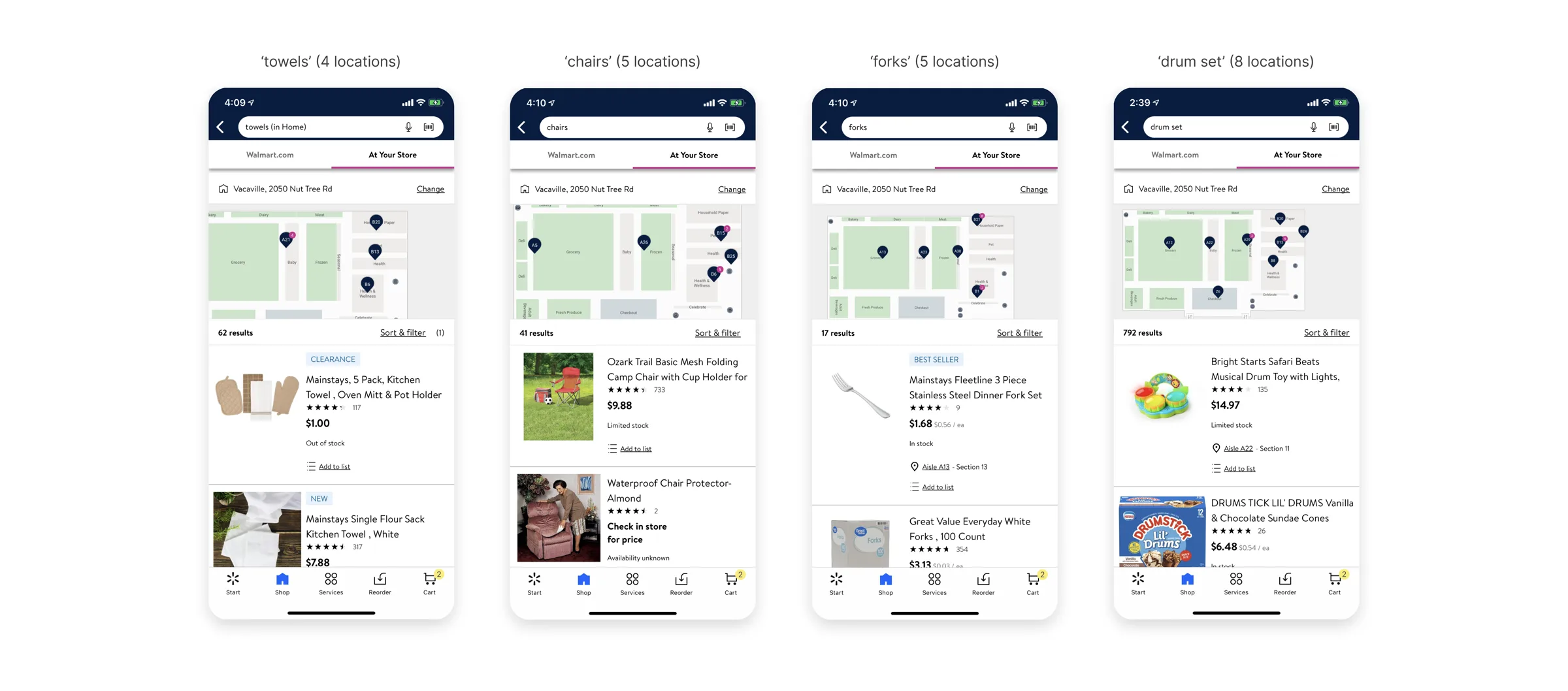
This is where the project earned its direction. Across the phased rollout, the research team ran three rounds of contextual study with Walmart customers—including shop-alongs observing real shoppers use Store Map to find items in-store. The pain points below surfaced directly from these sessions.
Generic search terms plus cross-department results are the root of downstream navigation confusion: With Walmart's enormous inventory across departments, categories, and subcategories, a single search term routinely matches items in multiple store locations.
Predictive search and category specification were meant to narrow this, but most customers type generic terms without preselecting a department—and 87% tap one of the top three predictive results, which return items across all departments.
The takeaway: the system needed to label and identify item type the moment results are generated, and let customers pivot their search preferences at any point.
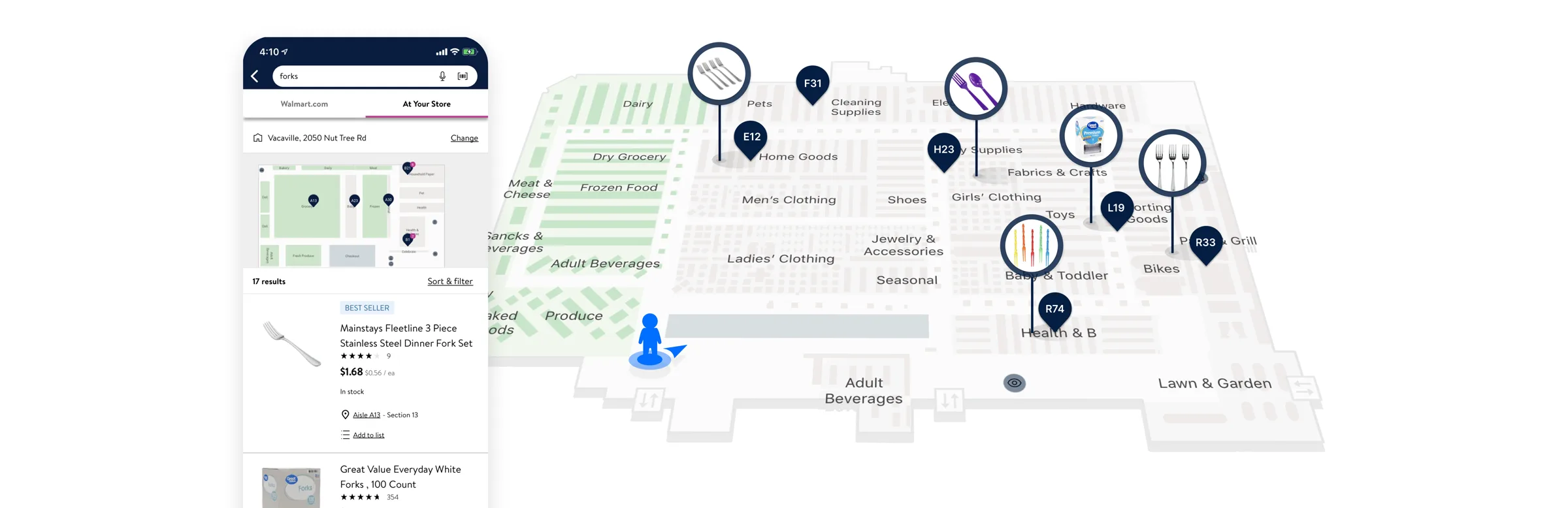
How do customers want to engage with Store Map? They need full visibility across locations—and the flexibility to switch modes. Two journeys had to be supported simultaneously, with the experience adapting freely as intent changed.
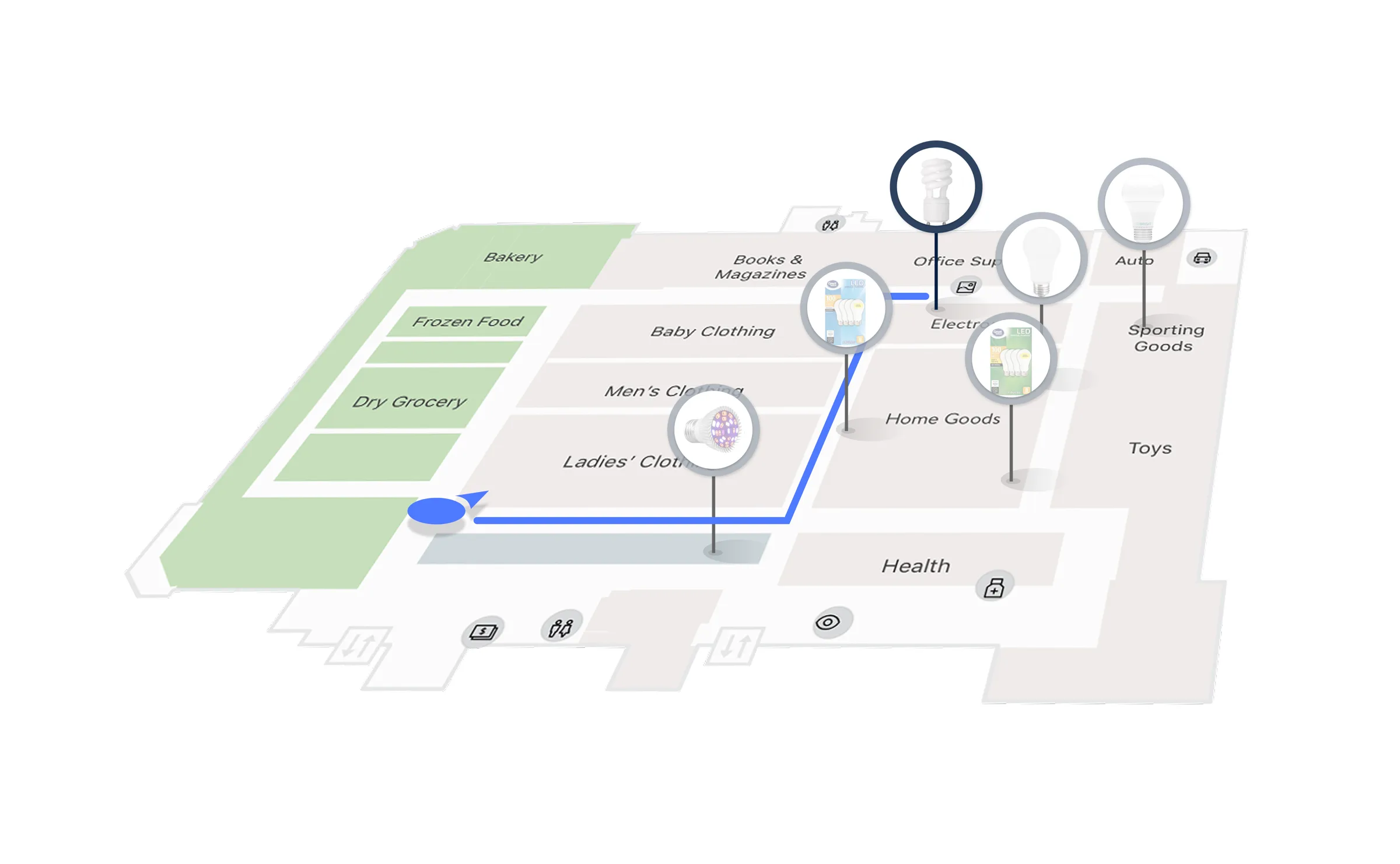
Locate and purchase: customer knows the exact item, wants to find it and check out
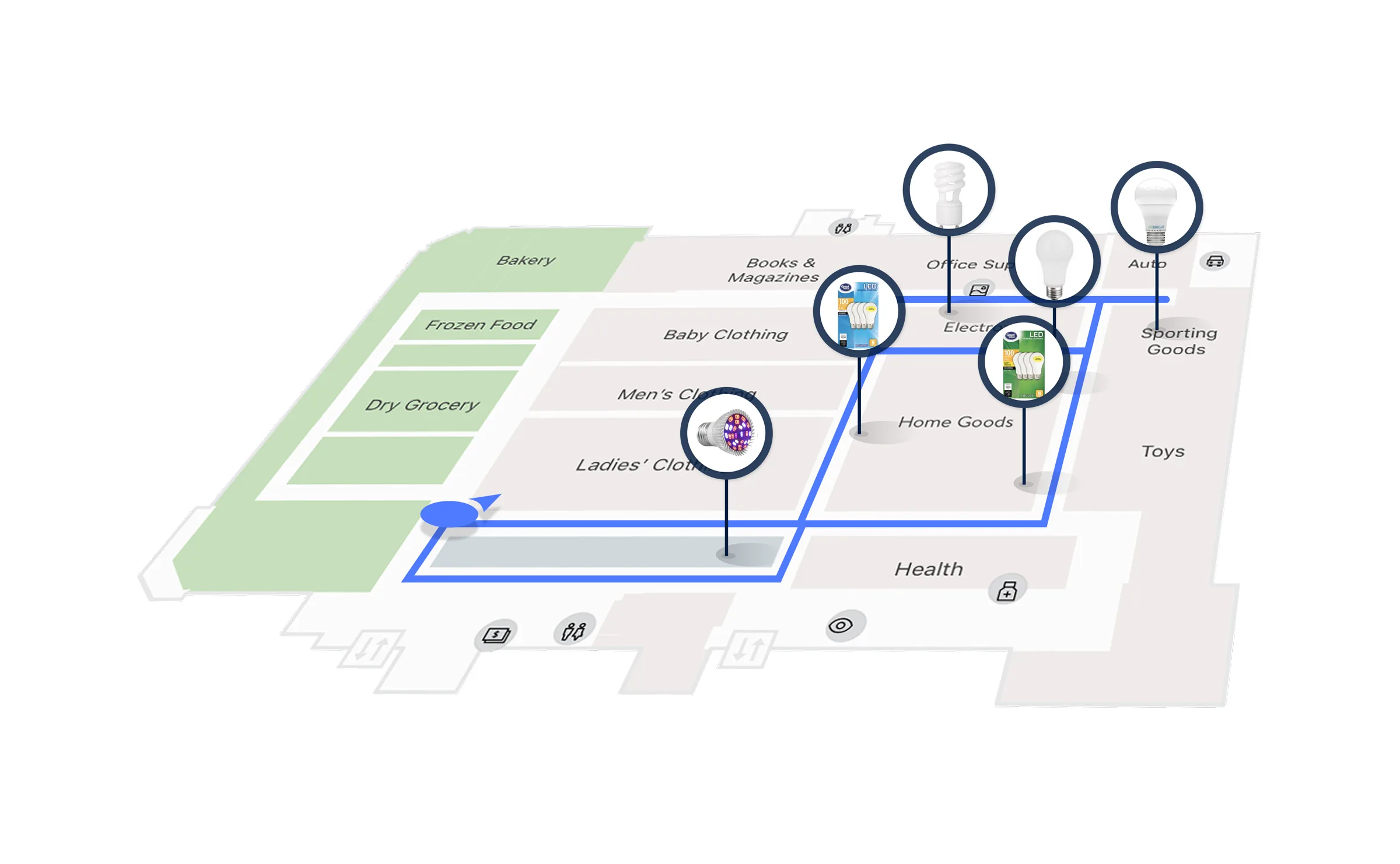
Browse and explore: customer has a general idea but wants to weigh options
Solution
Prioritizing the usability issues from study and testing, three principles guided the design:
Flexibility
Adapt to the customer's mission (searching, browsing, way-finding) with a high degree of navigational flexibility.
Cohesion
Eliminate visual ambiguity by bringing item browsing and way-finding into a single-unit experience.
Fluidity
Remove friction between item results and aisle pins at every point of the journey.
Rather than build net-new, I secured design and engineering leadership approval to bring three existing core-app components into Store Map: the bottom sheet, item carousel, and filter pills—a systems-minded choice that reused proven, accessible patterns instead of introducing bespoke ones. The bottom sheet became the connective tissue, unifying item results and map location into one experience:
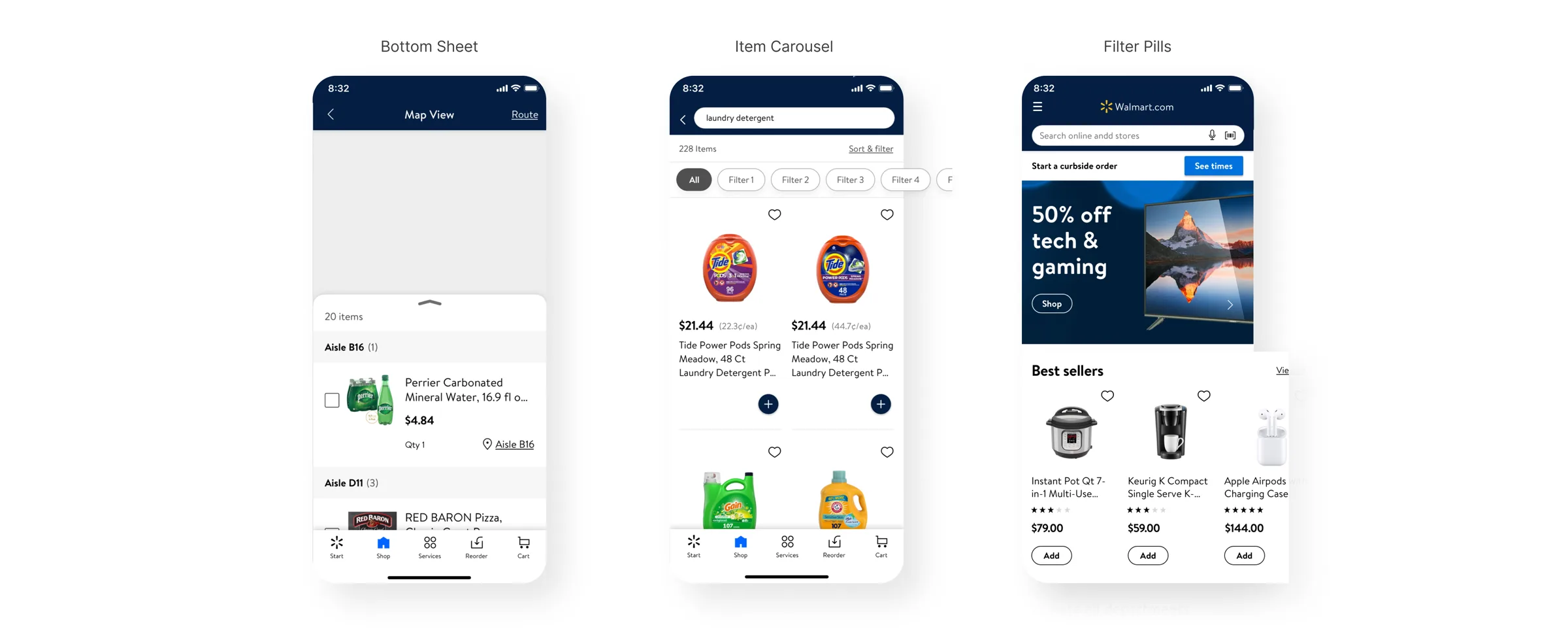
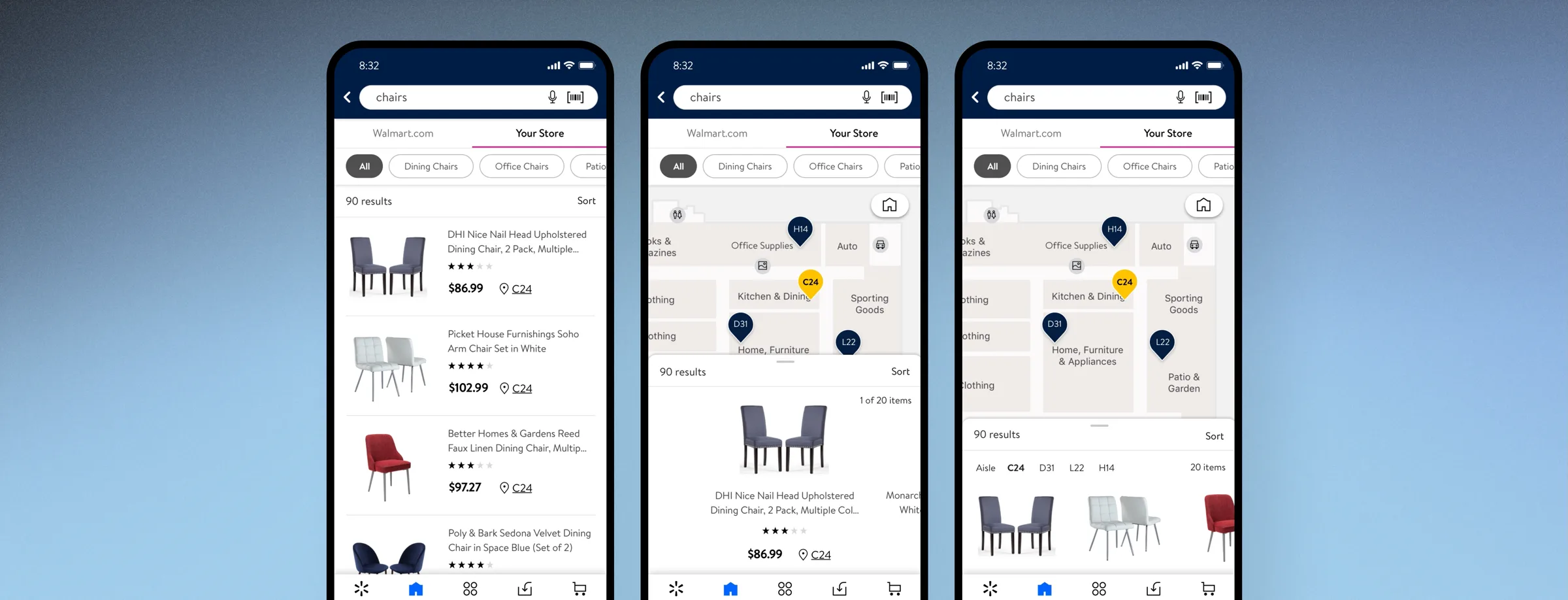
Rebuilding a more flexible and personalized experience: The introduction of the bottom sheet allows for added interactions and visual guides that help customers navigate effectively, and provide contextual information to users across various touch points of their journey.
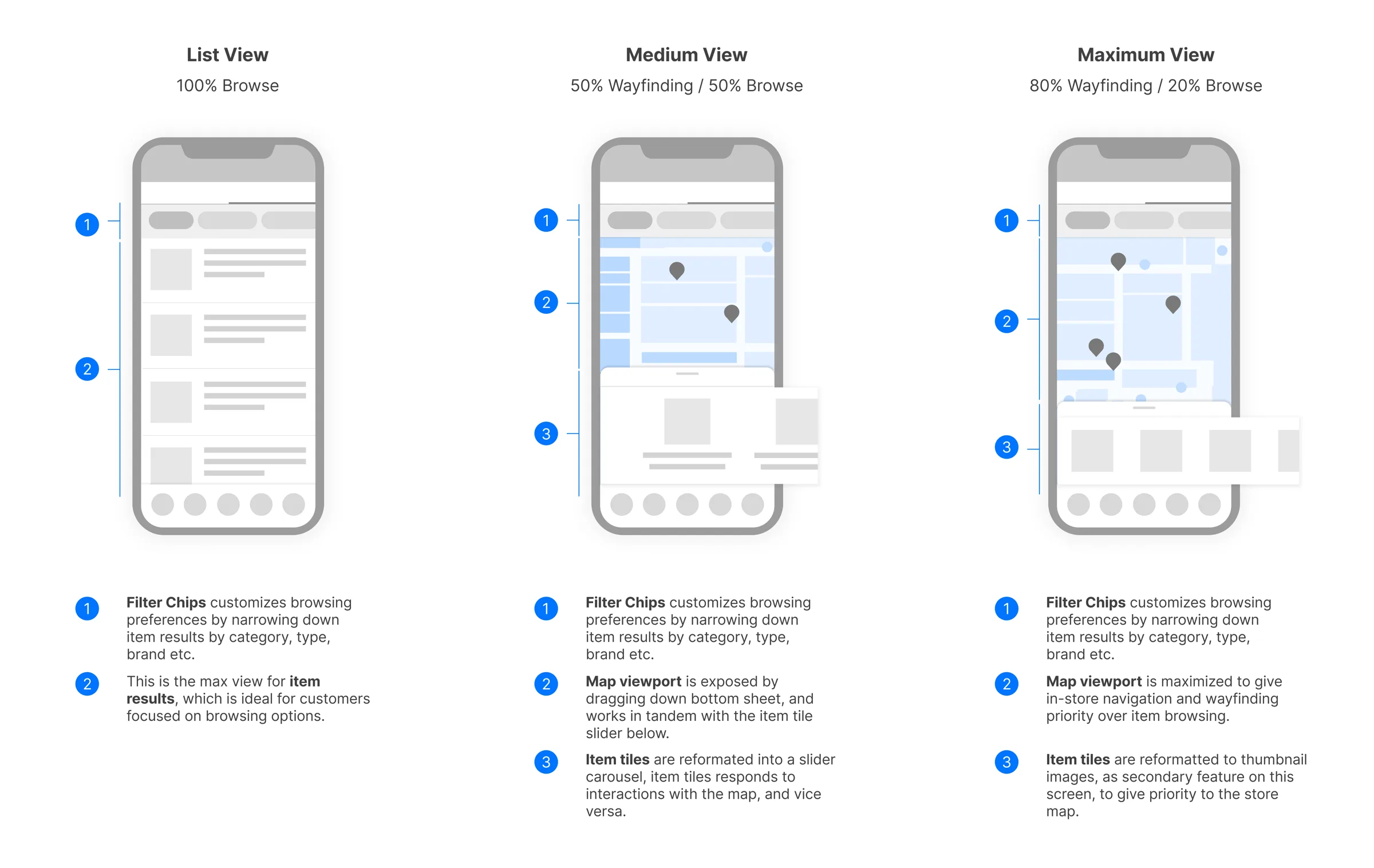
Connecting map and item results. Dragging the bottom sheet transitions between item tiles (browsing) and their location on the map (way-finding); in the medium viewport, tiles shift into a slider format.
Map view triggered from Item Tile. Alternatively, tapping an aisle pin on an item tile triggers the map view, and dragging the sheet back up returns to full list view.
Communicating aisle locations across departments. Carousel scrolling visually links each item result to its corresponding aisle from a bird's-eye view, so customers can browse across locations without confusion and tap any thumbnail for details. For more intentional shoppers, tapping a map aisle pin surfaces the item results in that specific location.
Tapping Map Aisle Pin. For customers who are intentional in their search and browse behavior, they can also tap on the map's aisle pins to view item results in that specific location. From the maximum map viewport, users can tap on item thumbnails to view item details.
Making filtering accessible in-context. Surfacing Sort & Filter inside the same bottom-sheet component let customers refine results without feeling their task was disrupted—making search accuracy and personalization part of the flow rather than a detour.
Outcome
The redesign resolved the disconnected-layers problem research had surfaced, delivering a unified experience with a markedly higher degree of navigational flexibility between Store Map and item results. The solution was validated through the same contextual-research program that shaped it, and the full component set—bottom sheet, item carousel, filter pills—was aligned and approved for implementation by design and engineering leadership.
Slated for Q1 2020, the launch was ultimately deprioritized amid Covid's disruption to in-store retail—but the work stands as a complete, research-validated design system for in-store way-finding, and a demonstration of how rigorous contextual research translates directly into interaction decisions.